
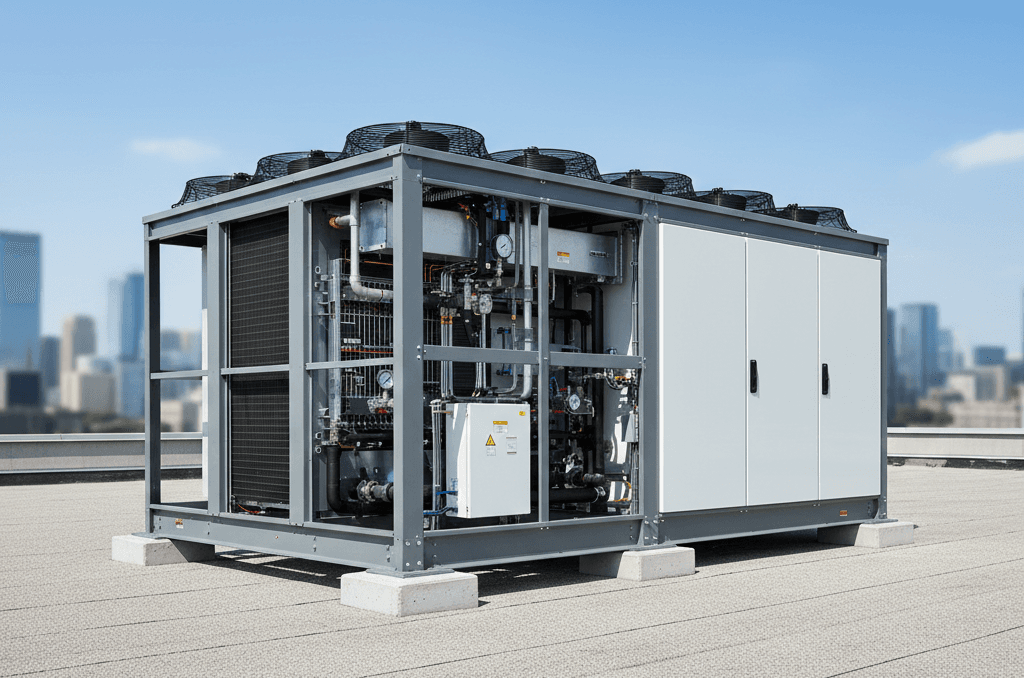
How to Choose a Chiller? Key Factors to Consider (2026 Guide)
A practical guide to selecting a chiller: cooling capacity, air vs water cooled systems, efficiency, and industrial applications.
How to Choose a Chiller? Key Factors to Consider (2026 Guide)
For large facilities, industrial plants, and commercial buildings, selecting the right cooling system is a major engineering decision. A poorly selected chiller can increase energy costs and reduce system stability. In this guide, we outline the key technical and practical considerations.
1. Cooling Capacity (kW or Tons)
The most important parameter is cooling capacity. Incorrect sizing may lead to:
- Insufficient cooling
- Higher energy consumption
- Frequent compressor cycling
Load calculations should consider building size, internal heat gains, solar load, and equipment.
2. Air-Cooled vs Water-Cooled
Air-cooled chiller
- Simpler installation
- Lower initial investment
- Suitable for small to medium projects
Water-cooled chiller
- Higher efficiency
- Ideal for large industrial/commercial projects
- Better long-term savings
3. Energy Efficiency (COP & EER)
COP and EER indicate system efficiency. Higher values mean lower electricity consumption.
4. Compressor Type
- Scroll
- Screw
- Centrifugal
Selection depends on project scale and cooling demand.
5. Control and Automation
Modern chillers integrate with BMS systems for optimized operation and remote monitoring.
Conclusion
Chiller selection should consider capacity, efficiency, compressor type, and service support. Professional design ensures long-term reliability and cost efficiency.